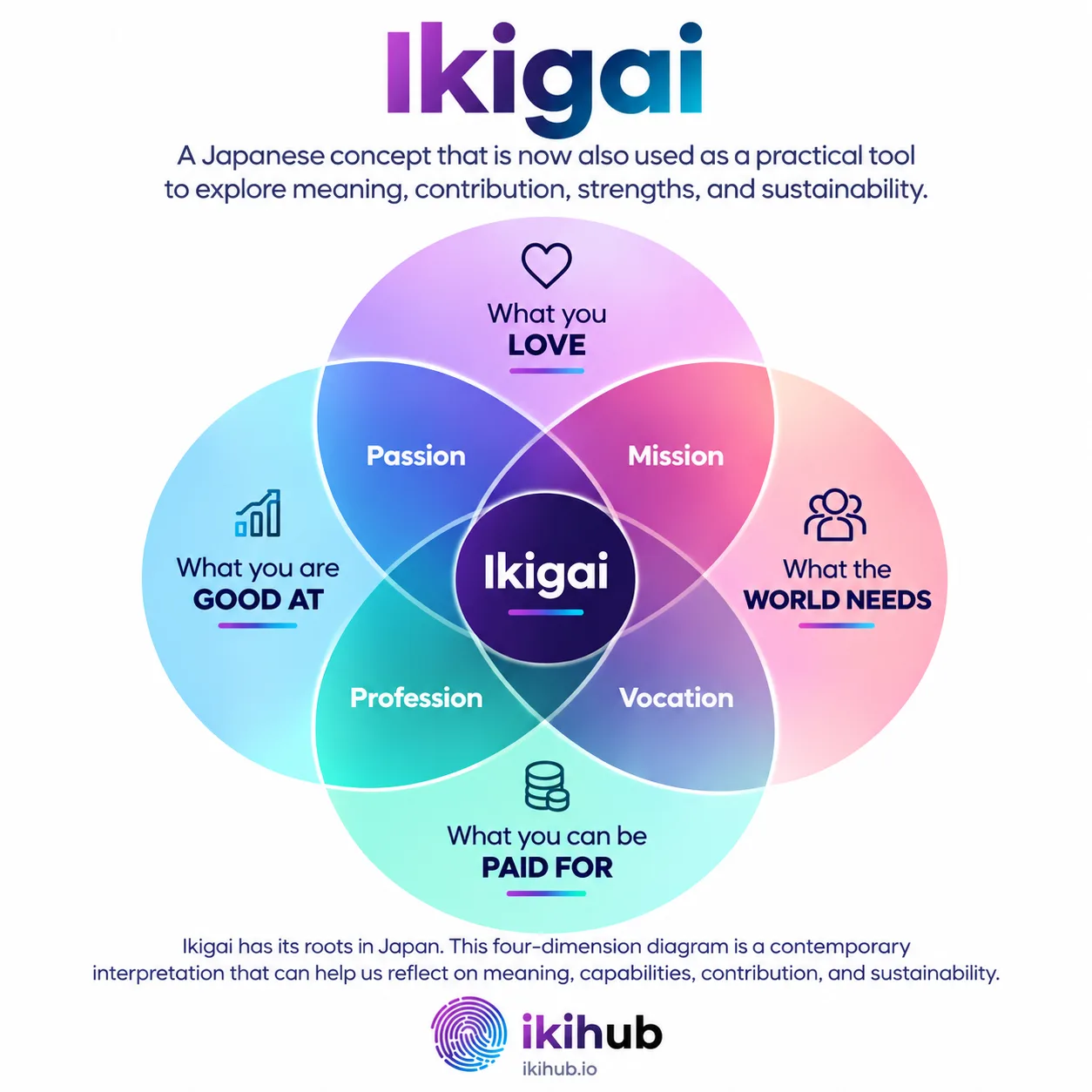
Ikigai is a concept of Japanese origin related to what gives life meaning, value, and a reason to be lived.
In the West, it is often represented with four questions: what you love, what you are good at, what the world needs, and what you can be paid for. That model can be useful, but for us it is only the beginning.
At ikihub, we are not trying to make you find a perfect phrase or force your life into four circles.
We are looking for something more useful: to help you recognize patterns in what you have already experienced, what you know how to do, what matters to you, what others find value in, and the direction you want to build.
Because often the problem is not that you have no purpose.
It is that you have not yet put into words what you already bring.
Your experience may feel scattered. Your strengths may come so naturally that you do not recognize them. You may know what you like, but not how to turn it into a decision. Or you may have a career, a business, and years of experience, yet feel that what you do no longer represents where you want to go.
That is where we use Ikigai.
Not as a formula to tell you who you should be, but as a tool for asking better questions:
What truly matters to you?
What do you know how to do that has value?
Where can you contribute?
Which part of that do you want to turn into work, a project, or a business?
And there is one additional question that is fundamental to ikihub:
What are you going to do with what you discover?
Because clarity without movement can become another form of endless reflection.
That is why at ikihub, Ikigai does not end at the center of a diagram. We connect it with your story, your strengths, your experience, and your current moment to turn it into a hypothesis for a direction you can put into practice.
Your Ikigai does not have to be definitive, either.
It can change as you change. It can take different forms at 25, 45, or 60. It can be present in your profession, in a company, in a cause, in a relationship, or in something you do simply because it makes your life more meaningful.
It is not about discovering a hidden answer.
It is about recognizing what is already there, giving it direction, and deciding what to do with it.